What Is Molecular Docking? How Does It Work? (Student-Friendly Explanation)
Textbooks and exam questions often ask: “What is molecular docking?” and “How does it work?” Here is a student-level answer that matches what teaching labs actually run — especially AutoDock Vina rigid-receptor docking — without overselling results as experimental fact.
Definition in plain language
Molecular docking is a computer simulation that predicts:
- Where a small molecule (the ligand) sits in a pocket on a larger molecule (usually a receptor protein) — the binding pose.
- How strongly that pose might bind — a score (for Vina: affinity in kcal/mol).
It is used in drug discovery to prioritize compounds before synthesis, and in university courses to practice structure-based thinking: hydrogen bonds, hydrophobic pockets, SAR tables, and honest limitations (Wikipedia: molecular docking).
Not the cartoon “lock and key” only
Early textbooks use a lock-and-key picture: rigid protein, rigid ligand. Real binding often involves induced fit — side chains move, water molecules leave, the pocket breathes. Standard homework docking (Vina with a rigid receptor) keeps the protein frozen and flexes only the ligand. That is a deliberate simplification for speed, not a picture of full biology.
When you write an essay, say: “Rigid-receptor docking approximates a snapshot of the protein; induced fit and explicit solvent are not modeled unless advanced methods are used.”
The two questions every docking paper answers
| Question | Computational piece | Output you cite |
|---|---|---|
| Where does it bind? | Search (pose generation) | 3D coordinates, overlay figures, RMSD vs crystal if available |
| How tight is it? | Scoring (pose ranking) | Affinity score, rank among analogs |
Search and score are coupled but not the same. A pose can score well yet look wrong in 3D (clashes, no H-bonds) — always visualize the top pose.
How does molecular docking work? (Pipeline)
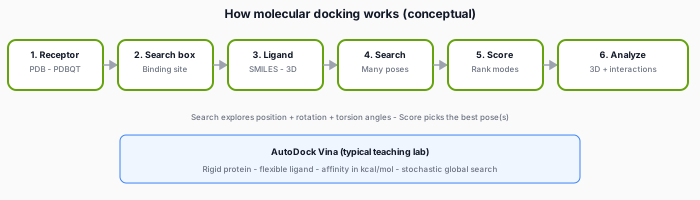
- Receptor preparation — Protein structure (PDB), protonation, atom types → receptor PDBQT (Meeko in modern Vina workflows).
- Binding site / search box — 3D region where the ligand is allowed to move (often from a co-crystal ligand).
- Ligand preparation — 2D structure → 3D conformer, charges, rotatable bonds → ligand PDBQT.
- Search algorithm — Samples many poses: position, orientation, torsions.
- Scoring function — Ranks poses; best mode gets the lowest Vina affinity (most negative).
- Analysis — PLIP-style interactions, SAR comparison, limitations paragraph.
Hands-on: step-by-step tutorial · Prep details: receptor & ligand preparation.
What is being “searched”? (Search space)
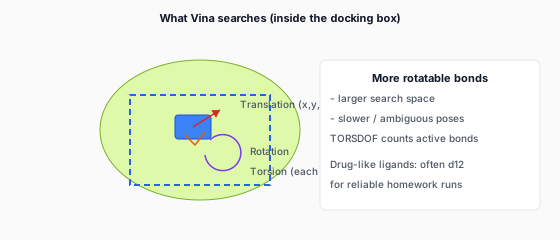
Inside the box, the program varies:
- Translation — x, y, z position of the ligand center
- Rotation — three Euler angles (orientation in the pocket)
- Torsions — one angle per rotatable bond (ligand flexibility)
The number of combinations explodes quickly. AutoDock Vina uses a stochastic global search (iterated local search) rather than brute force — fast enough for teaching libraries of dozens of ligands. Parameter exhaustiveness controls how hard it searches (default 8 on Dock).
Scoring functions — how poses get a number
A scoring function converts a pose into a predicted binding strength. Types you may see in lecture slides:
| Type | Idea | Examples |
|---|---|---|
| Force-field / physics-based | van der Waals + electrostatics | MM-GBSA rescoring (after docking) |
| Empirical | Weighted H-bonds, hydrophobic terms, fitted to data | AutoDock Vina, GlideScore (other programs) |
| Knowledge-based | Stats from known complex structures | DrugScore, PMF |
| Machine learning | Trained on structures or assays | GNINA, recent deep learning dockers |
What Vina’s affinity (kcal/mol) means
Vina reports predicted binding affinity in kcal/mol. More negative usually means stronger predicted binding for that pose, that receptor, that box:
- −8 kcal/mol is modeled as more favorable than −5 kcal/mol in the same run
- It is not a measured ΔG from calorimetry
- Typical precision is often ~1 kcal/mol or worse — treat close scores as ties until 3D review
Reading results: interpret affinity & poses. Official context: AutoDock Vina manual.
Rigid receptor vs flexible receptor
| Model | What moves | When used in courses |
|---|---|---|
| Rigid receptor (Vina default) | Ligand only | Most undergrad labs — fast, reproducible |
| Flexible side chains | Selected protein rotamers | Advanced electives; Meeko + specialized workflows |
| Induced fit / MD | Whole protein + solvent | Research projects, not typical 1-week homework |
If the binding site changes shape when ligands bind (apo vs holo), rigid docking on an apo structure can mis-rank analogs — see crystal structure (holo vs apo).
Docking vs virtual screening vs molecular dynamics
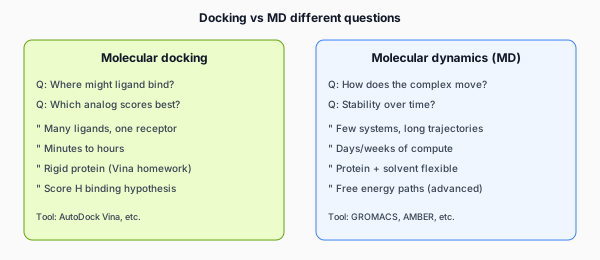
- Single-ligand docking — One (or few) compounds, detailed pose analysis.
- Virtual screening — Same receptor, many ligands (10²–10⁶ in industry; 20–40 in class). Dock ranks the library. Class guide: virtual screening assignment.
- Molecular dynamics (MD) — Simulates motion over picoseconds–microseconds with solvent; answers stability and pathways, not “which of 50 SMILES wins this afternoon.”
Where you meet docking in university courses
| Course type | Typical task |
|---|---|
| Medicinal chemistry | Dock analog series; discuss SAR + interactions |
| Biochemistry / structural biology | Redock co-crystal; compare to published pose |
| Pharmacy / toxicology | Hypothesis for off-target binding + ADMET flags |
| Computational chemistry | Compare Vina to MD or other scoring (advanced) |
What molecular docking is not
- Proof of binding in cells, animals, or humans
- A substitute for IC50, Ki, or binding assays
- Guaranteed correct if the PDB or binding box is wrong
- The same as “AI drug discovery” black-box scores without a methods section
- A replacement for thinking about chemistry — scores support stories, they do not write them
Glossary (exam-ready)
| Term | Short definition |
|---|---|
| Ligand | Small molecule that binds (your SMILES / drug candidate) |
| Receptor | Target macromolecule (usually protein) |
| Binding site / pocket | Region on the receptor where ligands bind |
| Pose | One specific 3D placement + conformation of the ligand |
| Mode | Ranked pose from Vina (mode 1 = best score) |
| Search box | 3D grid region for ligand search |
| Scoring function | Model that ranks poses by predicted affinity |
| Rigid receptor | Fixed protein atoms during docking |
| Redock | Dock the known co-crystal ligand to validate setup |
Sample introduction paragraph (essay / report)
Molecular docking was used to predict the binding mode and relative affinity of a series of small-molecule inhibitors against the catalytic site of [protein name] (PDB [ID]). The receptor was treated as rigid; ligand flexibility included rotatable bonds as defined in the PDBQT parameterization. Poses were generated and scored with AutoDock Vina; the lowest-scoring pose per ligand was retained for interaction analysis. Results are presented as computational hypotheses to guide interpretation of structure–activity trends and are not experimental binding measurements.
Try it online (no install)
Dock runs AutoDock Vina + Meeko in the cloud: PDB ID, batch SMILES, free Review setup, PDF + ZIP for lab reports. Start: Dock app · Hub: molecular docking for students · 4-week plan: learning roadmap.