Published example from a real 6LU7 batch job (three drug-like SMILES). Run your own structure on the home page to get a private report with downloadable ZIP and PDF export.
Every completed docking job includes a results.zip alongside the on-page report and PDF. Use the ZIP for PyMOL/Chimera, offline tables, and reproducibility — the PDF is a human-readable summary of the same run.
Job root (once per run)
result.json
Summary of docked ligands, failures, scores, and redock status.
Paste the paragraph below into your Methods section; numbered references follow.
Suggested citation paragraph (Methods / Computational details)

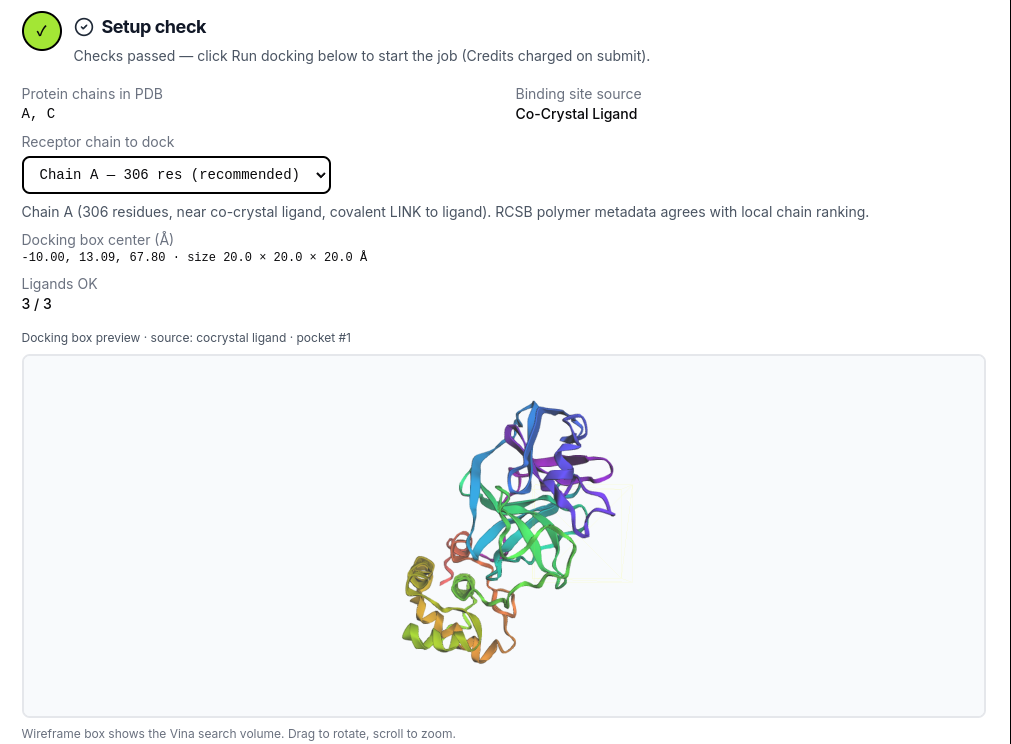
Molecular docking was performed using the cloud-based workflow at MolecularDocking.online (pipeline v1.9.4)[1], utilizing AutoDock Vina 1.2.7[2] with Meeko receptor/ligand preparation (Meeko 0.7.1)[3]. The receptor structure was prepared from PDB 6LU7 (chain A). The search grid was centered at (-10.00, 13.09, 67.80) Å with dimensions 20.0 × 20.0 × 20.0 Å (source: cocrystal ligand). Ligands were built from SMILES using RDKit 2025.3.6 (ETKDG embedding, MMFF94 minimization)[4] with dimorphite-DL 2.0.2 protonation at pH 7.4[7]. AutoDock Vina was run with exhaustiveness=8, num_modes=9, and energy_range=3 kcal/mol; the top-ranked pose(s) per ligand were exported. Protein–ligand interactions were analyzed with PLIP 3.0.0[5]. Pose quality was validated with PoseBusters 0.6.5 (University of Oxford docking configuration)[6]. Computational binding scores and ADMET estimates are model predictions only; experimental validation is required.

References

[1] MolecularDocking.online. Cloud molecular docking workflow (https://molecular-docking.online). Accessed 2026.
[2] Eberhardt J, Santos-Martins D, Forli S, Olson AJ. AutoDock Vina 1.2.0: new docking methods, expanded force field, and Python bindings. J Chem Inf Model. 2021;61(8):3891-3898.
[3] Forli S, Huey R, Pique ME, Sanner MF, Olson AJ. Computational protein-ligand docking and virtual drug screening with the AutoDock suite. Nat Protoc. 2016;11(5):905-919.
[4] RDKit: Open-source cheminformatics. https://www.rdkit.org/ (accessed 2024).
[5] Salokas LM, Viswanath S, Aho AJ, et al. PLIP 2021: expanding the scope of the protein-ligand interaction profiler to DNA and RNA. Nucleic Acids Res. 2023;51(W1):W530-W534.
[6] Buttenschoen GF, Morris GM, Deane CM. PoseBusters: AI-based docking methods fail to generate physically valid poses or cause unintended bias. Nat Methods. 2024;21(3):472-480.
[7] Swain M. dimorphite-DL: an open-source program for enumerating the ionization states of drug-like small molecules. J Cheminform. 2019;11(1):14.
[8] Cock PA, Antao T, Chang JT, et al. Biopython: freely available Python tools for computational molecular biology and bioinformatics. Bioinformatics. 2009;25(11):1422-1423.
[9] pocketeer: apo binding-site prediction tool used for pocket ranking in this pipeline.
[10] Schrödinger LLC. The PyMOL Molecular Graphics System, Version 2.0. (Open-source build when enabled in Advanced options.)
PLIP. Salokas LM, Viswanath S, Aho AJ, et al. PLIP 2021: expanding the scope of the protein-ligand interaction profiler to DNA and RNA. Nucleic Acids Res. 2023;51(W1):W530-W534.
PoseBusters. Buttenschoen GF, Morris GM, Deane CM. PoseBusters: AI-based docking methods fail to generate physically valid poses or cause unintended bias. Nat Methods. 2024;21(3):472-480.
dimorphite-DL. Swain M. dimorphite-DL: an open-source program for enumerating the ionization states of drug-like small molecules. J Cheminform. 2019;11(1):14.
Biopython. Cock PA, Antao T, Chang JT, et al. Biopython: freely available Python tools for computational molecular biology and bioinformatics. Bioinformatics. 2009;25(11):1422-1423.
pocketeer. pocketeer: apo binding-site prediction tool used for pocket ranking in this pipeline.
PyMOL. Schrödinger LLC. The PyMOL Molecular Graphics System, Version 2.0. (Open-source build when enabled in Advanced options.)
3. Binding mode interpretation
Discussion-style summary of predicted binding (similar to Fiverr manuscript support).
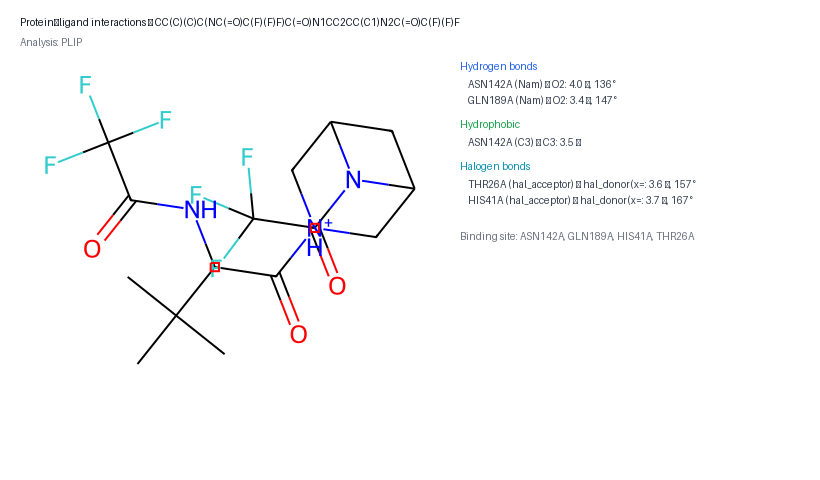
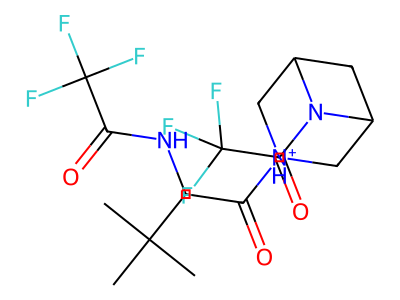
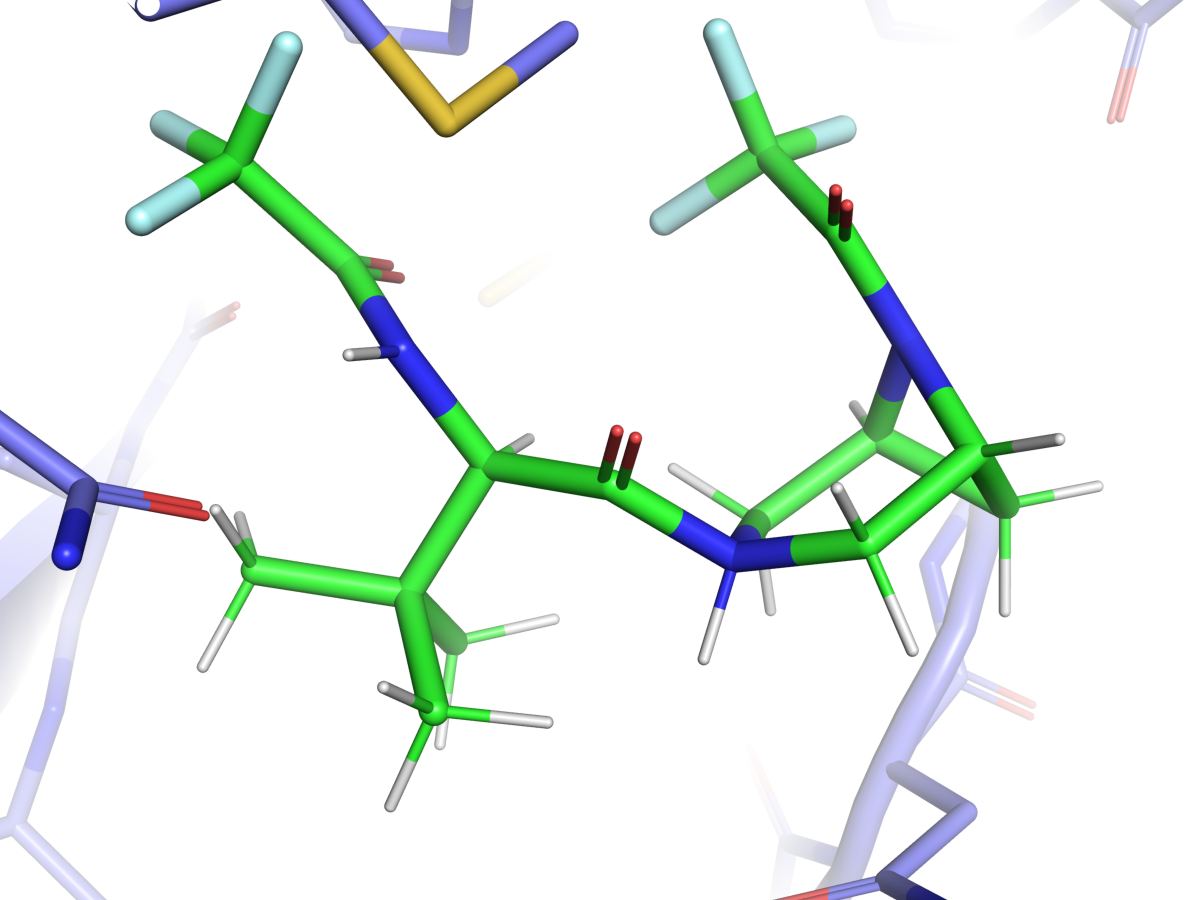
AutoDock Vina predicted moderate binding for CC(C)(C)C(NC(=O)C(F)(F)F)C(=O)N1CC2CC(C1)N2C(=O)C(F)(F)F (best score -6.21 kcal/mol). Among the screened compounds, CC(C)(C)C(NC(=O)C(F)(F)F)C(=O)N1CC2CC(C1)N2C(=O)C(F)(F)F ranked as the top hit. Key predicted interactions (PLIP) include 2 hydrogen bond(s) with ASN142A, GLN189A; hydrophobic contacts involvingASN142A; halogen bond(s) with HIS41A, THR26A. The ligand is surrounded by pocket residues including ASN142A, GLN189A, HIS41A, THR26A. Multiple docking modes have similar scores; consider inspecting alternate poses in the structure files. These results are computational predictions only and should be validated experimentally (e.g., SPR, ITC, or cell-based assays) before drawing mechanistic conclusions.
Close top posesPoseBusters QC pass
The best mode leads by 0.14 kcal/mol (<0.25 kcal/mol). The top pose is still the ranking winner, but alternate poses are close enough to review in the structure files.
PoseBusters: 22/22 checks passed.
Validated with PoseBusters (University of Oxford docking configuration).
Detected contacts (5 total)
PLIP
2 hydrogen bond(s)
1 hydrophobic contact(s)
2 halogen bond(s)
Pocket residues: ASN142A, GLN189A, HIS41A, THR26A
4. Publication figures
Ready-to-use PNG images for slides and manuscripts (also included in the ZIP).
2D interaction diagram
LigPlot-style map of PLIP-detected hydrogen bonds, hydrophobic contacts, and salt bridges.
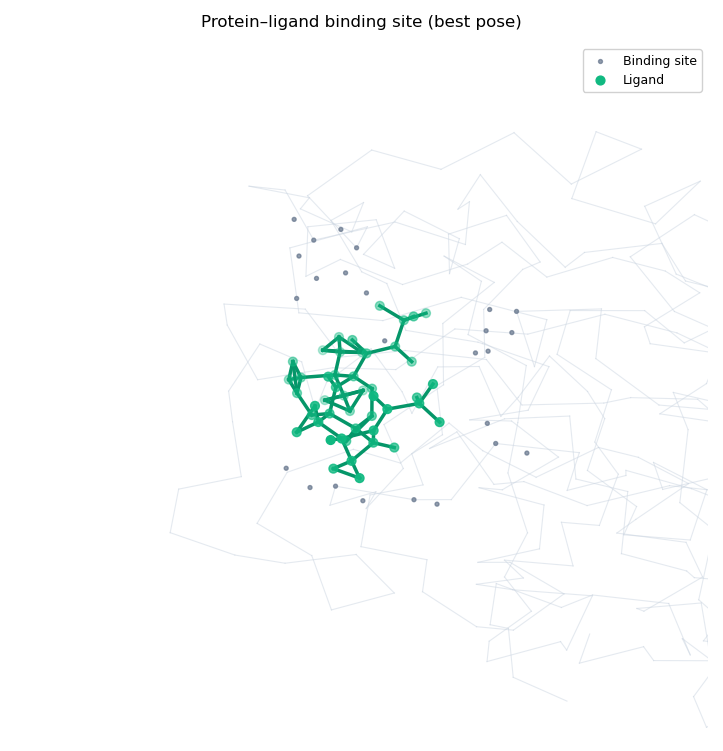
Binding-site overview
Highlighted pocket with docked ligand (matplotlib 3D overview).
2D ligand structure
Chemical structure of the protonated ligand used for docking.
PyMOL binding-site render
Ray-traced publication figure (cartoon receptor + sticks). Best hit only for batch jobs.
5. 3D structure view
Interactive protein–ligand complex. Select ligand and Vina pose (top 3 exported). Pose 1 is the best-scoring mode.
Drag to rotate · scroll to zoom · right-drag to pan. Top 3 Vina poses are exported when available; pose 1 is the best-scoring mode.
6. ADMET summary
RDKit-based drug-likeness estimates (Lipinski, Veber, QED). Not experimental ADMET.
Drug-like (rules pass)
Molecular weight (Da)
404.3
LogP
0.04
TPSA (Ų)
70.9
H-bond donors / H-bond acceptors
2 / 3
Rotatable bonds
2
QED
0.639
Lipinski
Pass
Veber
Pass
Computational ADMET estimates from RDKit descriptors; not experimental ADMET data.
7. Per-ligand docking results (all compounds)
Each row is one compound in this batch (3 total). Sorted by status, then affinity. ADMET columns included for screening comparison.
#
Compound
SMILES
Status
Best affinity (kcal/mol)
Δ to 2nd
Pose confidence
Pose QC
MW (Da)
Lipinski
QED
1
Nirmatrelvir
CC(C)(C)C(NC(=O)C(F)(F)F)C(=O)N1CC2CC(C1)N2C(=O)…
OK
-6.21
0.14
Close top poses
PoseBusters QC pass
404.3
Pass
0.64
2
Ibuprofen
CC(C)Cc1ccc(C(C)C(=O)O)cc1
OK
-6.03
0.23
Close top poses
PoseBusters QC pass
205.3
Pass
0.75
3
Aspirin
CC(=O)Oc1ccccc1C(=O)O
OK
-5.05
0.40
Moderate separation
PoseBusters QC pass
179.2
Pass
0.47
Run notes
Receptor chain used: A
Binding site box uses co-crystal ligand center (20×20×20 Å).
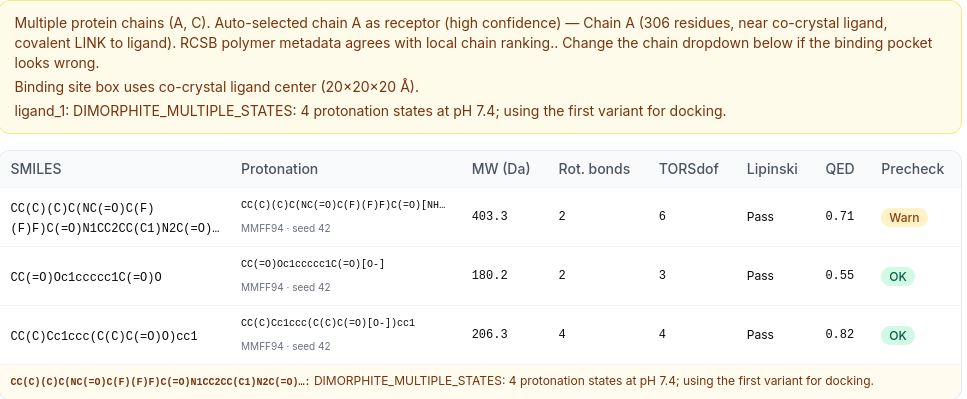
ligand_1: DIMORPHITE_MULTIPLE_STATES: 4 protonation states at pH 7.4; using the first variant for docking.
ligand_1: Reused validated ligand PDBQT (protonation locked from Review setup).
ligand_2: Reused validated ligand PDBQT (protonation locked from Review setup).
ligand_3: Reused validated ligand PDBQT (protonation locked from Review setup).
Limitations
Rigid receptor only (no flexible side chains).
One protein chain per job (select chain when PDB has multiple chains).
Ligand protonation uses dimorphite_dl at job pH (default 7.4) or per-ligand ph override (4.0–10.0).
Ligand input: SMILES, MOL block, or SDF (first record).