Molecular Docking for Toxicology & ADMET: How to Use Docking in Coursework
Searches for molecular docking toxicology spike every term when pharmacy, environmental health, and medicinal chemistry courses assign “predict toxicity with docking.” Instructors usually want a mechanistic hypothesis and a structured in silico table — not a regulatory risk dossier. This guide maps three defensible uses of AutoDock Vina in toxicology reports, shows how Dock’s RDKit ADMET columns fit next to affinity, and lists language that will get you marked down if you over-claim.
What your instructor probably wants (vs what Google implies)
Forum posts often confuse:
- Target binding at a toxicity-related protein (e.g. CYP active site, nuclear receptor, ion channel homology model) — docking fits here.
- Whole-organism toxicity prediction (LD50, hepatotoxicity incidence) — needs assays and models beyond Vina; cite limits explicitly.
- ADMET property screening (solubility, permeability, rule-of-five) — Dock reports include descriptors; they are filters, not clinical outcomes.
If the rubric says “QSAR” or “read-across,” confirm whether docking is required or optional. When docking is required, pair it with one paragraph on what experiment would test the hypothesis.
Three honest roles for docking in toxicology coursework
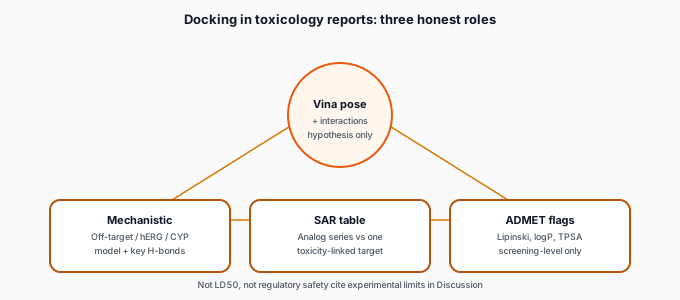
1. Mechanistic / off-target binding hypothesis
Example assignment wording: “Propose whether compound X could interact with hERG / CYP2D6 / PPARγ based on structure.” You dock into a documented site on a crystal or homology model, then describe H-bonds and hydrophobic contacts — same discipline as medicinal chemistry, different biological narrative.
- Cite the target review (e.g. cardiotoxicity mechanisms, CYP inhibition literature).
- Use hedged language: “consistent with,” “suggests potential,” not “will cause QT prolongation.”
- Include a reference ligand (known inhibitor or toxicant analog) redocked in the same pocket.
Homology models: state template PDB, sequence identity, and that side-chain placement in the binding site is uncertain. See crystal structure vs model FAQ.
2. Structure–activity at a toxicity-linked target
Example: rank a series of environmental contaminants or drug metabolites by Vina score against one receptor (aryl hydrocarbon receptor ligand-binding domain, androgen receptor, etc.). This is a standard SAR table assignment — interpret trends (halogen size, H-bond donors), not absolute kcal/mol as lethal dose.
- Batch dock on Dock: paste one SMILES per line; outputs label
ligand_1,ligand_2, … automatically. - Credits: 1–3 ligands = 1 credit; larger sets use
ceil(n/5)(Screening Pack ≈ 40 ligands for 8 credits). - Align chemistry discussion with interaction columns (PLIP), not ranking by score alone — interpreting affinity & poses.
3. ADMET flags alongside docking (screening level)
Dock PDF/ZIP includes RDKit-derived molecular weight, logP, TPSA, H-bond donors/acceptors, rotatable bonds, Lipinski and Veber rule pass/fail, and QED. In toxicology reports, present them as developability / oral exposure screens, not organ toxicity proof:
Among the analog series, compound 3 showed the most favorable Vina affinity (−7.2 kcal/mol) against the modeled AR ligand-binding site, with halogen–Leu contact consistent with known agonist chemotypes. RDKit descriptors: MW 342, logP 3.1, TPSA 74 Ų, Lipinski pass, QED 0.62 — suggesting oral-like properties at a computational screening level only. Hepatotoxicity and in vivo endocrine effects were not evaluated.
Common toxicology targets students dock (and caveats)
| Target theme | Typical structure source | Student pitfall |
|---|---|---|
| hERG / Kv11.1 | Homology model or open-state structures | Treating any pose as “will block channel” without assay |
| CYP450 active sites | CYP crystal with inhibitor | Docking parent drug but assignment asks about metabolite — need metabolite SMILES |
| Nuclear receptors (AR, ER, PXR) | Holo agonist/antagonist PDBs | Confusing agonist vs antagonist pocket conformations |
| Phase II enzymes | Variable quality apo/holo | Apo pocket + rigid Vina → poor redock; say in limitations |
| Covalent toxicants | Non-covalent docking only in standard Vina | Do not claim covalent bond formation unless using specialized workflows |
What docking cannot support (marking red flags)
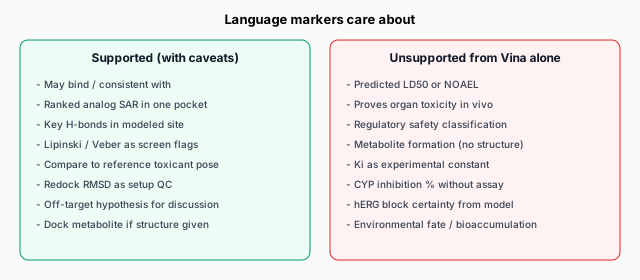
- LD50, NOAEL, safety margin from affinity — unsupported; use literature toxicity data if available.
- Regulatory classification (GHS, REACH) from one protein pose.
- Metabolic pathway prediction without drawing metabolite structures and docking them separately.
- Experimental Ki or IC50 as if Vina kcal/mol were measured — report as predicted binding energy only.
- Environmental persistence / bioaccumulation — outside protein docking scope unless course provides separate QSAR tools.
Worked example: hERG “could this compound block the channel?”
Many pharmacy courses ask for a hypothesis, not a clinical prediction. A defensible report might:
- Cite a review linking hERG block to QT risk class.
- Use a published homology model or open-state structure; state template and limitations.
- Redock a known blocker (e.g. dofetilide-class chemotype) — report RMSD.
- Dock your compound + two analogs; compare interaction patterns (aromatic stacking vs cation–π), not only score.
- State that patch-clamp or binding assays would be required to validate.
If your compound ranks worse than the reference blocker, write “weaker predicted channel interaction” — not “safe for patients.”
How markers often grade toxicology docking reports
| Criterion | Strong | Weak |
|---|---|---|
| Target justification | Review cited, endpoint named | Random PDB from Google |
| Methods | Vina, pH, box, n ligands | “Online docking website” |
| Controls | Reference toxicant redocked | Test compounds only |
| ADMET | Descriptors as screening flags | Lipinski = “non-toxic” |
| Discussion | Limits + one experiment | LD50 implied from score |
End-to-end workflow on Dock
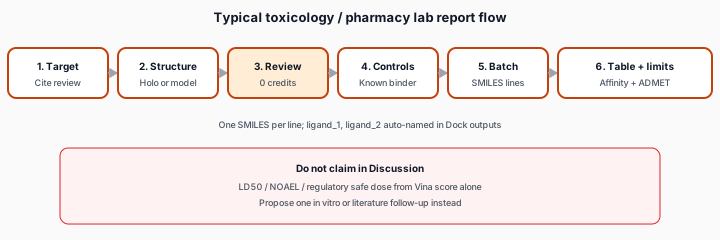
- Literature anchor — One review or primary paper linking protein target to the toxicity endpoint discussed in class.
- Structure — Prefer holo PDB with bound ligand; redock reference before your series (prep guide).
- Review setup (0 credits) — Verify chain, box, protonation pH 7.4 preview at Dock.
- Controls — Known binder or class toxicant in the same job as test compounds.
- Batch run — SMILES one per line; download PDF + ZIP within 7-day retention.
- Table — Columns: ID, affinity, 1–2 interactions, Lipinski/Veber, one-sentence trend.
Results table template (copy and adapt)
| Compound | Vina score (kcal/mol) | Key interactions | Lipinski | logP / TPSA | Note |
|---|---|---|---|---|---|
| Reference toxicant | −8.1 | H-bond Asp…; π–π | Pass | 2.8 / 81 | Redock RMSD 1.2 Å |
| Test 3 | −7.2 | Halogen–Leu | Pass | 3.1 / 74 | Best in series; in silico only |
Methods paragraph (toxicology + ADMET)
The androgen receptor ligand-binding domain (PDB XXXX, holo) was prepared with Meeko (protonation pH 7.4, dimorphite_dl). AutoDock Vina (exhaustiveness 8) was run via the Dock platform with a binding box centered on the co-crystal ligand (20 Å cube). Test compounds and a reference agonist were docked as SMILES inputs (n = 12). Pose quality was assessed by redocking the reference ligand (RMSD < 2 Å). RDKit 2D descriptors and Lipinski/Veber rules were computed for screening-level ADMET discussion. No molecular dynamics or experimental binding assays were performed.
Discussion: one strong limitations paragraph
Markers reward self-awareness. Include:
- Rigid receptor — no induced fit at the toxicologically relevant site.
- Homology model uncertainty if applicable.
- Score ≠ clinical outcome; ADMET rules ≠ organ toxicity.
- Proposed follow-up: e.g. CYP inhibition assay, hERG patch clamp, or literature comparison to in vivo study.
When to use other tools in the same course
If the module covers read-across or OPERA/QSAR Toolbox, use those for endpoint prediction and docking for mechanistic illustration — cite both in Methods. Tool comparison: Vina online vs local. Small-library screen: virtual screening assignment guide.
Start a run: Dock · Hub: students online · Learn basics: 4-week roadmap · Pricing: credits.